Handleless Kitchen Cabinets: Which Opening System Fits?
“Handleless” describes the appearance of a kitchen, but it does not identify how its doors and drawers open. You might grip the edge of a shaped door, reach into a recessed profile or press a front to release it. These options can look similar in a photograph and feel different in daily use.
Choose the opening system while planning the cabinets. It influences door details, the hardware specification and the way the kitchen works around appliances.
Three ways to remove a projecting handle
An integrated finger pull provides a grip within the door or drawer-front design. Ask to see the actual profile: the depth, shape and position of the grip matter more than its name.
A recessed profile creates a space behind or beside the front where fingers can reach. Its line becomes part of the kitchen’s design. Look at how that line continues around corners and where it stops at tall units.
A push-to-open system releases a door or drawer when its front is pressed. The specified mechanism determines how it opens and closes. A flat door without a visible handle does not, by itself, prove that this is the system being used.
For each option, open the sample with the movement you would naturally use. A showroom display is more informative when you test the mechanism rather than only view the finish.
Soft closing is a separate specification
Do not assume that every push-to-open fitting can be combined with any soft-close hinge or runner. Ask for the compatible system and its intended cabinet application.
For example, Blum’s TIP-ON BLUMOTION combines mechanical opening with soft closing in its specified drawer applications. That establishes that the combination exists; it does not mean that every push-to-open door uses it.
The quote should identify the selected hardware and where it will be installed. “Blum hardware” is less precise than a schedule distinguishing hinges, runners and opening mechanisms.
Test the cabinets you use most often
Try the waste-sorting drawer, a wide pot drawer, an upper door and a tall storage door. These movements are different. For a drawer, ask for a representative demonstration under the intended use conditions rather than judging only an empty display.
Use this short comparison:
- Can everyone in the household comfortably grip or activate the front?
- Does the opening movement work near the dishwasher and adjacent drawers?
- Can you reach the upper cabinets without an awkward wrist position?
- Is the same action suitable for frequently used storage and occasional storage?
- Can you clean the grip or profile easily with the recommended method?
A kitchen does not need one mechanism everywhere. A combination can be worth considering when it solves a specific access issue and is drawn consistently.
Look at the finish where hands touch
Handleless fronts are touched at the grip or opening point. Examine a sample under daylight and the type of lighting planned for the room. Compare how marks appear and how the manufacturer recommends cleaning that finish. Our comparison of MDF, melamine and thermofoil explains how door materials and finishes differ.
Avoid treating “matte,” “glossy” or “anti-fingerprint” as a complete maintenance specification. Ask for the exact door product and care instructions. The cabinet design guide provides context for choosing the fronts and storage together.
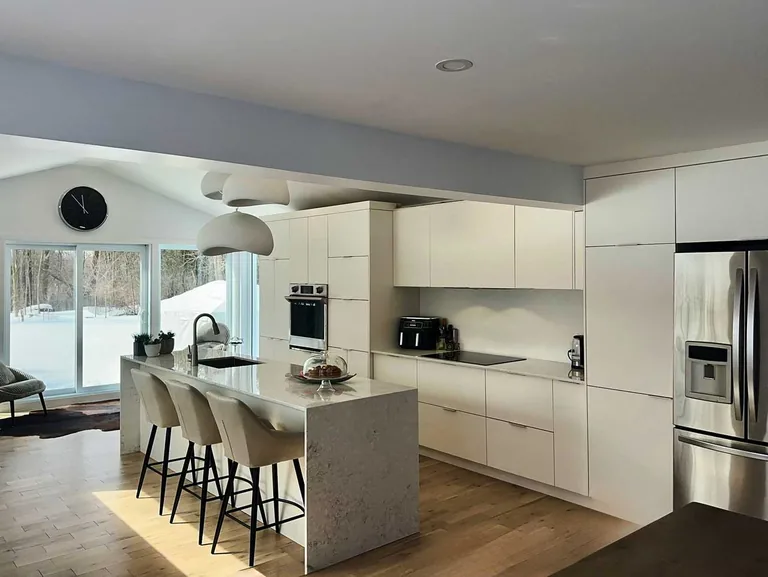
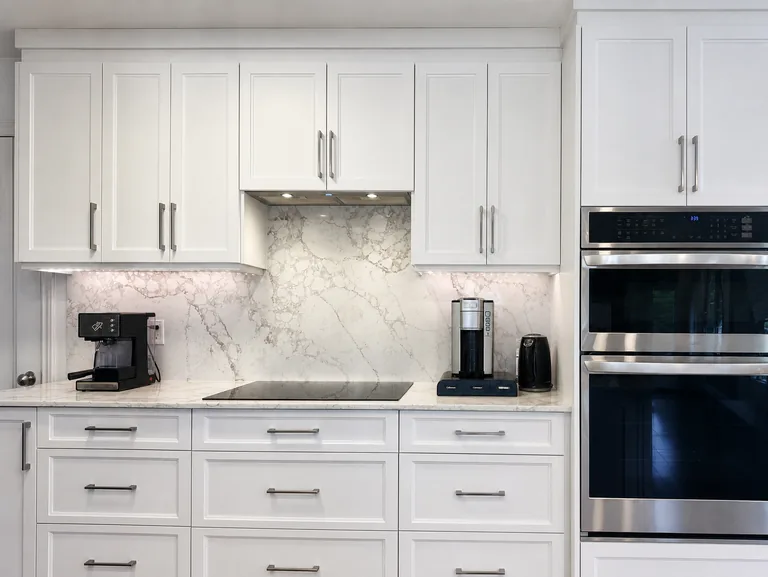
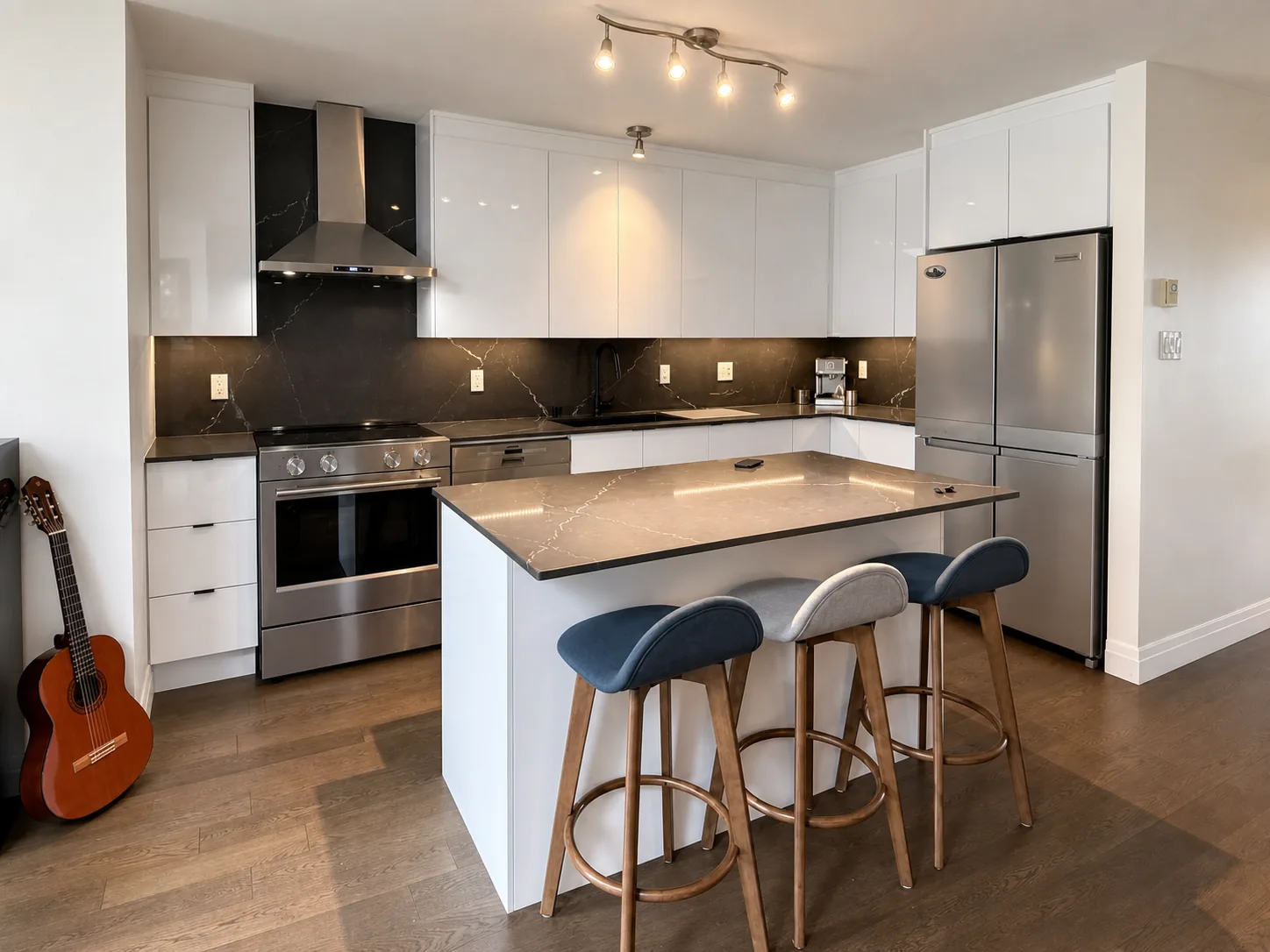
The Pierrefonds handleless kitchen is a visual example of white slab fronts paired with a dark veined counter. Use it to assess the overall lines and contrast; confirm the proposed mechanism separately on your own drawings and samples. Our kitchen cabinet styles page sets that handleless kitchen beside four other kitchens we built.
Coordinate appliance handles and cabinet lines
An oven or dishwasher handle can interrupt an otherwise continuous run. That may be intentional, but it should appear in the design before fabrication.
Check appliance clearances, access to controls, door swings and the relationship between opening profiles and end panels. In a small kitchen, a clean front is useful only if the room still works when doors are open.
Turn the preference into a clear cabinet specification
For each cabinet group, record the door finish, opening system, closing system and any special fitting. Review a sample before signing off on the drawings.
When discussing custom kitchen cabinets as part of a complete renovation, bring photographs of the look you like and explain how you cook. The best opening system is the one that supports those routines, with details you have actually tested.
Contact Limakdéco to arrange a sample visit for your complete kitchen project. Bring your preferred door style and the storage you use most often so the opening systems can be compared in context.