Bathroom Countertops in Montreal: Materials and Prices
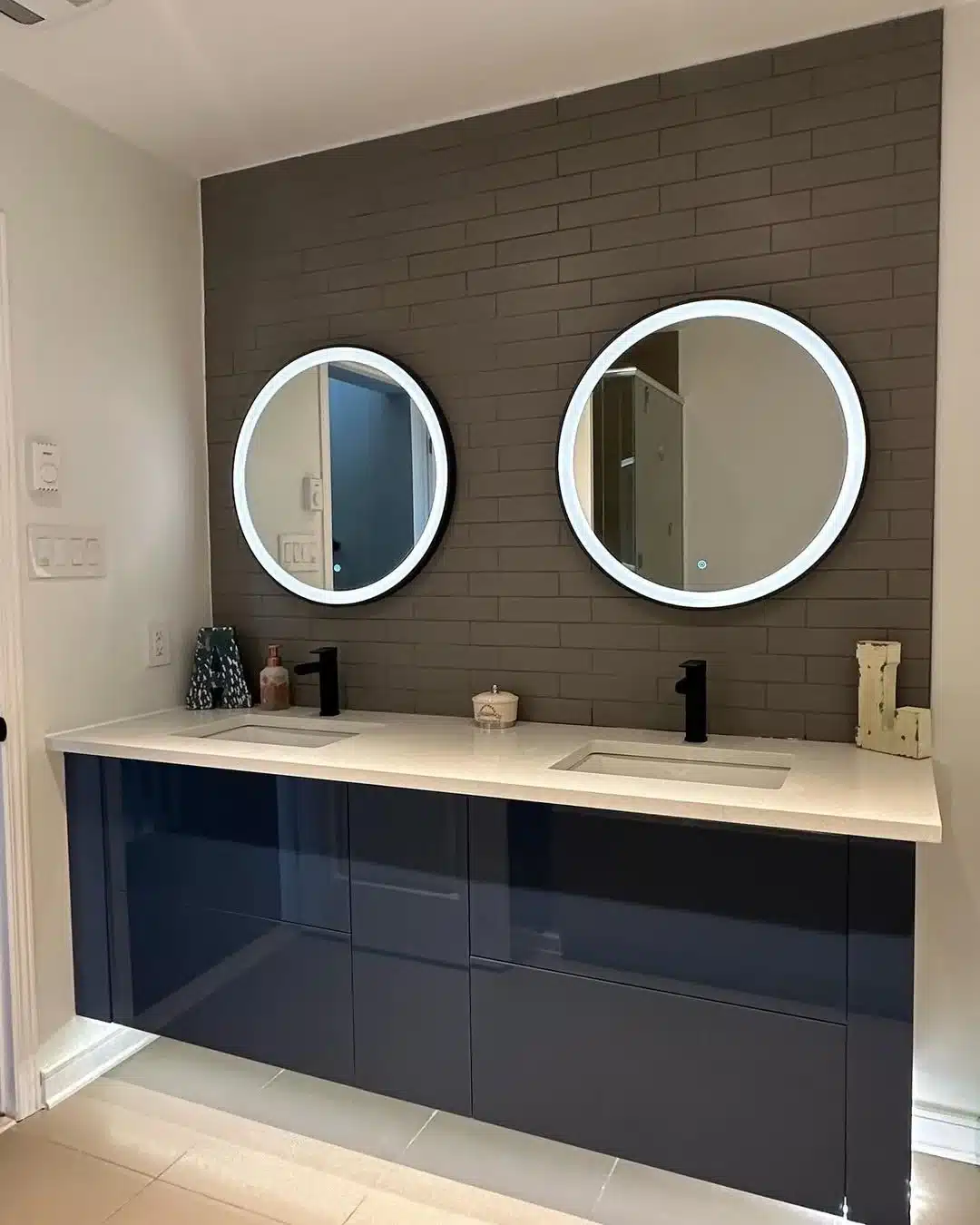
For bathroom countertops in Montréal, compare water exposure, cosmetics, hot styling tools and the sink detail before choosing a slab. Quartz, quartzite and porcelain can all suit a vanity, but they have different care and fabrication requirements. Matching the kitchen countertop is an option when the selected product works in both rooms.
Here is how we decide, in our Saint-Laurent workshop, between the three materials we actually install on vanities.
What makes a bathroom countertop different from a kitchen one
In a kitchen, the enemies are pan heat, knives and red wine. In a bathroom they are three other things, and they are less obvious.
Water, and specifically standing water. A kitchen splash gets wiped within the minute. In a bathroom the water sits: around the sink rim, behind the faucet, in the joint where the backsplash meets the wall. That is where porous countertops fail, not in the middle of the slab.
Cosmetics. Nobody mentions this one and it causes most of the damage we get called back for. Hair dye, nail polish remover, self-tanner, perfume: aggressive chemicals, often pigmented, often spilled and found the next morning. A kitchen counter never meets any of it.
Hot tools. Hot styling tools can concentrate heat on a small area. Temperature and contact time vary by appliance, so use a heat-resistant mat and follow the countertop product’s instructions.
One last difference, and it is good news for your budget: a vanity top is small. A standard vanity runs 6 to 12 square feet against 40 to 60 for a kitchen. That changes things, because a top that size can often be cut from a leftover slab. More on that below.
Quartz for a bathroom vanity
Quartz is our default recommendation in a bathroom, and the reasoning is simpler than it is in a kitchen.
Quartz is engineered stone bound with resin. Its non-porous surface generally needs no sealing, but non-porous does not mean stain-proof or chemical-proof. Wipe spills promptly and follow the selected brand’s care guide.
Expect 80 to 180 $ per square foot, installed, depending on the collection.
Keep hot styling tools on a heat-resistant mat. Direct or prolonged heat can damage a quartz surface; the type of damage depends on the product and exposure.
Quartzite and porcelain, when they are worth it
Quartzite is natural stone with slab-specific colour and veining. Ask the fabricator whether the selected slab and finish need sealing and how to assess future maintenance. Use a protective mat for hot tools and wipe spills promptly.
Expect 90 to 220 $ per square foot, installed.
Porcelain offers low water absorption and thin profiles. Check the exact product’s chemical, heat and edge-care instructions. A wall-hung vanity still needs support designed for the complete cabinet, top and sink assembly.
Expect 60 to 120 $ per square foot, installed.
Its limit is the edge: on a thin slab, visible thickness is built up with a mitred joint, and that joint has to be done properly or it shows. That is workshop work, not site work.
Material comparison
| Material | Water resistance | Upkeep | Installed price (sq ft) |
|---|---|---|---|
| Quartz | Non-porous, no sealant | Follow the product care guide | 80 to 180 $ |
| Quartzite | Ask about slab-specific sealing | Assess sealing as advised | 90 to 220 $ |
| Porcelain | Low water absorption | Clean as directed; protect edges | 60 to 120 $ |
Integrated, undermount or vessel: the countertop decides
Plenty of clients pick the sink before the countertop. It should be the other way round, because the material closes doors.
The undermount sink is the setup we install most. There is no rim for water to pool against, which is exactly the problem described above. It needs a polished edge all the way around the cutout, so it needs a material that polishes well: quartz and quartzite yes, thin porcelain, trickier.
A vessel sink and an undermount sink can both be possible, depending on the porcelain product, thickness, opening and support detail. Confirm compatibility with the fabricator before ordering the sink.
An integrated sink creates a coordinated appearance, but its construction, seams and repair options depend on the product. Ask whether the basin can be replaced independently and how joints are maintained.
If you have not settled on the cabinet yet, our guide to choosing a vanity covers dimensions and heights before the countertop enters the picture.
How we template and install a vanity top
The template is taken on the installed, levelled vanity, never from a drawing. Montreal bathroom walls are rarely square, especially in prewar apartments in the Plateau or Rosemont, and a top cut to drawing dimensions leaves a gap against the wall that cannot be recovered.
This is where the small size of the top becomes a real advantage. A 6 to 10 square foot vanity top can very often be cut from a leftover slab from a kitchen project. The slab is already paid for, it is already in the workshop, and the price per square foot drops for you without the material changing. We check our remnant inventory as a matter of course before ordering a new slab for a vanity. Nobody thinks to ask, so we offer it.
Countertop fitting and plumbing reconnection are separate tasks. Confirm the fitting appointment, sink support, joint sealing and the plumber’s return visit in the written scope; same-day reconnection depends on the project.
For the cabinet itself, we also build the custom bathroom vanities these tops sit on, which saves you working around stock cabinet dimensions.
FAQ
Can I use the same material as my kitchen?
Often, yes, if the selected product suits the sink detail and expected use. Check its care instructions for cosmetics, heat and any sealing requirements. Our countertop material comparison covers the kitchen side in detail.
How long between templating and installation?
The interval depends on slab availability, cutouts, the fabricator’s schedule and the plumbing appointment. Confirm templating, fitting and reconnection dates in your quote.
Do I need a backsplash?
Not mandatory, but recommended behind the faucet. That is the exact spot where water eventually finds its way between the countertop and the wall.
Torn between two materials? Come see and touch the slabs at our Saint-Laurent showroom. The visit is free, and you get a written quote within 48 hours. Get in touch to book a time.
Prices above are indicative 2026 ranges in Canadian dollars, not a quote. Collections, remnants, cutouts and minimum fabrication charges affect a small vanity top. Confirm inclusions and taxes for your selected material. For care, see HanStone’s quartz care guide, which warns against acetone and nail polish remover, and follow the instructions for the brand actually installed.